

Average Australian Home Loan and Mortgage Size
The average Australian home loan can be a useful way to understand what other borrowers are financing, but it should never be treated as a target for how much you personally should borrow.
Loan sizes can move considerably from year to year as property prices, interest rates, buyer demand and lending conditions change. They can also differ significantly between Queensland, New South Wales, Victoria and other parts of Australia.
According to the latest ABS lending data (June quarter 2026), the average new owner-occupier dwelling loan in Australia is $731,000. In Queensland, the average is higher at $751,000. But there is an important point to understand before comparing your mortgage with these figures.
These statistics measure new loan commitments for dwellings. They are not the average amount still owing across every existing Australian mortgage, and the ABS dwelling-commitment series excludes refinancing.
That distinction matters.
Someone refinancing a $400,000 mortgage should not look at a $731,000 average new home loan and assume they are somehow borrowing too little. Likewise, a first home buyer should not assume they need to borrow anywhere near the national average simply because other buyers are doing so.
This guide looks at what the latest figures really mean, how the average mortgage size in Australia has changed since 2024, how Queensland compares, what repayments on a large home loan can look like and why your own borrowing capacity matters much more than the national average.
What is the Average Australian Home Loan Right Now?
According to the latest national housing lending figures available at the time of writing, the average Australian home loan for a new owner-occupier was $731,000 in the June quarter 2026, according to the latest ABS Lending Indicators.
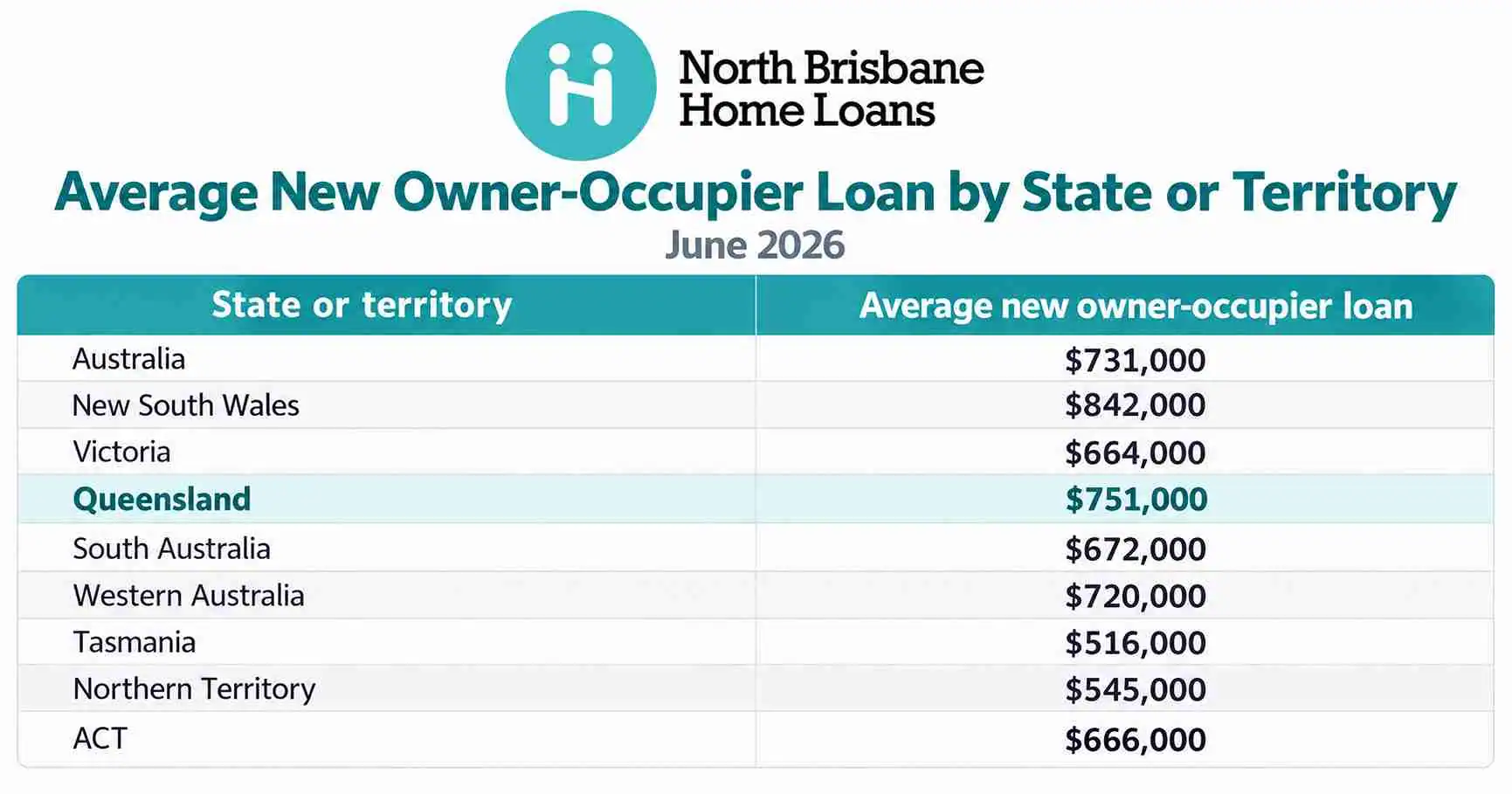
The data shows why a single national average needs context. A borrower in Queensland is currently operating in a lending market where the average new owner-occupier loan is around $20,000 higher than the Australian figure, while New South Wales sits substantially higher again.
What Does “Average Mortgage Australia” Actually Mean?
When people search for the average mortgage Australia figure, several different measurements can be mixed together.
You might mean:
- the average size of a newly approved owner-occupier loan
- the average investor loan
- the average first home buyer loan
- the average outstanding mortgage balance
- the typical monthly repayment.
They are not the same statistic.
For this guide, the main figure we use is the average size of a new owner-occupier dwelling loan commitment, because it provides a consistent government data series showing how new borrowing is changing over time.
The ABS notes that its dwelling loan commitment data includes finance for construction of new dwellings, purchases of new dwellings and purchases of existing dwellings. Refinancing is excluded from the series.
That is why it is more accurate to describe $731,000 as the average new owner-occupier home loan rather than suggesting every Australian mortgage holder owes that amount.
Average Mortgage Size in Australia: 2024 vs 2025 vs 2026
The average new owner-occupier loan increased from $666,000 in December 2024 to $737,000 in December 2025, before easing slightly to $731,000 in June 2026. Historical average Australian home loan figures show just how quickly the numbers have changed. There is rarely one reason behind the movement.
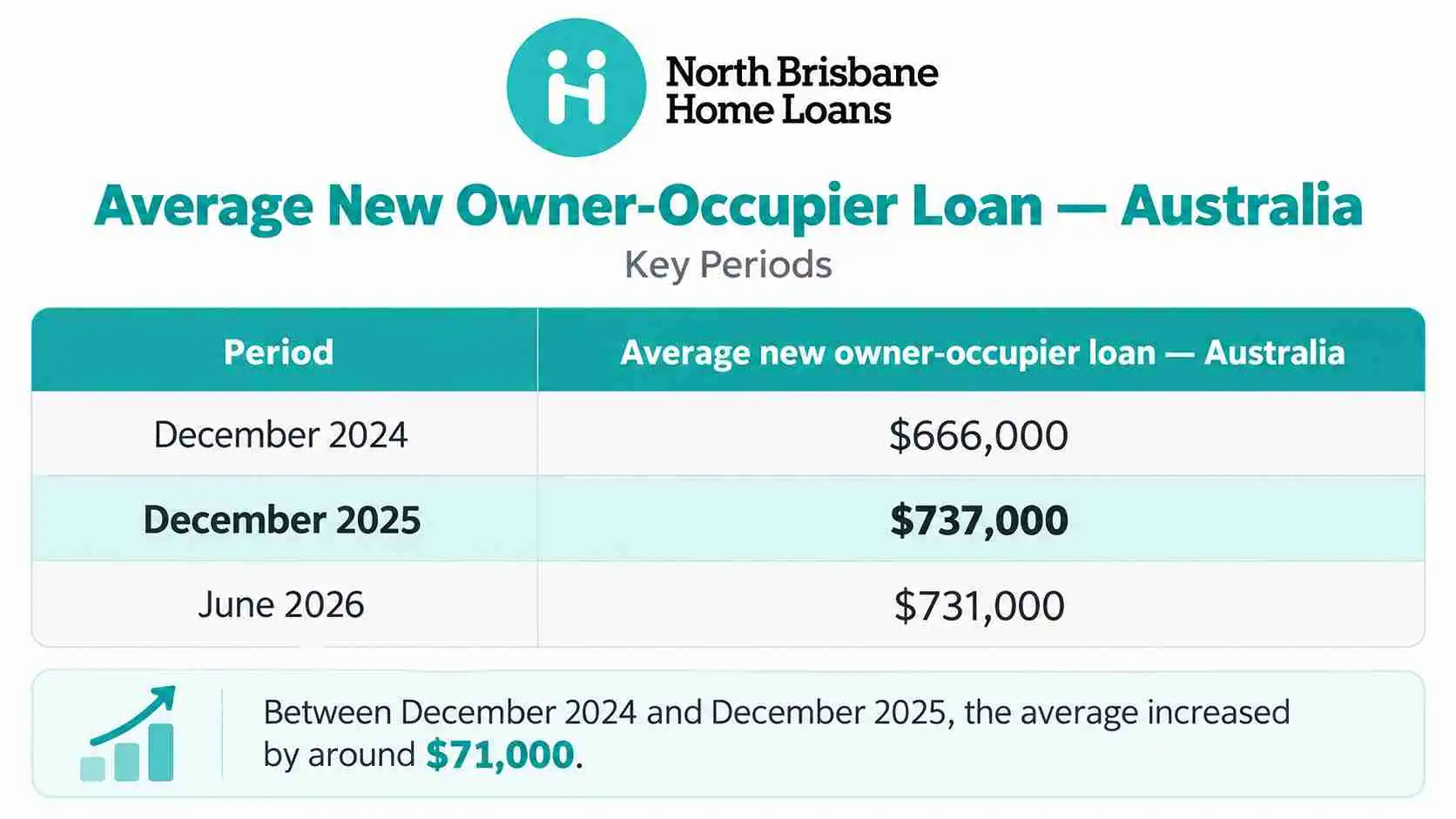
This does not mean every Australian borrower took on an extra $65,000 between December 2024 and June 2026 of debt.
The average is influenced by the mix of properties being financed, locations where borrowing occurs, property prices and the borrowers entering the market in a particular quarter.
It is best used as a trend indicator, not as a personal borrowing benchmark.
Why Has the Average Australian Home Loan Changed So Much?
Several factors can contribute to changes in the average loan size. Property prices are an important influence, because buyers may need to borrow more when the cost of purchasing a home rises. The result can also be affected by where borrowing is taking place, the types of properties being purchased and the mix of first home buyers, upgraders and other borrowers entering the market.
Deposit sizes and available equity can also make a difference. For example, an upgrader who has built substantial equity in an existing property may be able to contribute more towards the next purchase, while a first home buyer may need to finance a larger proportion of the property price.
Interest rates and lender serviceability requirements can influence the amount buyers are able to borrow as well. Changes in borrowing capacity can affect the types of properties buyers pursue and, in turn, the mix of loans being recorded in the national average.
This is why the average new owner-occupier loan figures are best viewed as a broad measure of borrowing trends rather than a target for individual borrowers. A rising or falling average reflects changes across the wider housing and lending market, not a recommendation for how much any one household should borrow.
Average Home Loan Queensland vs Australia
If you are buying in Brisbane or elsewhere in Queensland, the national average only tells part of the story. Property prices can affect how much buyers need to finance, but averages can also move because of where purchases are occurring, the types of homes being bought, how much deposit or equity borrowers contribute and which borrowers are entering the market.
For example, Queensland’s average owner-occupier loan increased from $635,000 in December 2024 to $751,000 in June 2026, while other states followed different paths over the same period.
Interest rates and lender serviceability settings can also influence how much buyers are able to borrow.
The latest average owner-occupier home loan figures by state show that the average new owner-occupier loan in Queensland reached $751,000 in the June quarter 2026, around $20,000 above the average Australian home loan of $731,000. That puts the Queensland average around $20,000 above the national figure.
Queensland’s average has also increased significantly over the past few years:
That does not mean a Brisbane buyer should expect to borrow $751,000, or that this is the amount a lender will approve.
Average loan sizes are influenced by the properties being purchased, where borrowing is occurring, the size of borrowers’ deposits or equity and the mix of people entering the market.
For someone buying in North Brisbane, the more useful question is:
What purchase price and loan repayment can comfortably fit your own income, deposit and ongoing expenses?
North Brisbane Home Loans can help you work that out before you make an offer, so you have a clearer idea of the price range and lenders that may suit your circumstances.
How Much is the Average First Home Buyer Loan?

First home buyers often start from a different financial position to upgraders who already have equity in a property.
First home buyers took out 29,319 owner-occupier loans worth $18.4 billion in the June quarter 2026, an average of about $627,000 per loan, according to the latest ABS first home buyer lending figures.
That average is noticeably below the broader new owner-occupier average, but it should still not be treated as a recommended loan amount.
Your first home loan will depend on factors including:
- how much deposit you have saved
- your income and employment position
- existing debts and credit limits
- your household expenses
- the property price
- interest rates
- the lender’s assessment criteria
- any first home buyer assistance you may qualify for.
If you are getting ready to buy your first property, our first home buyer loans page explains the finance process in more detail and how NBHL can help you compare lenders.
Average Owner-Occupier vs Investor Loan Sizes
Owner-occupiers and property investors do not necessarily borrow the same amounts.
As of June 2026, the latest Australian housing lending data showed:
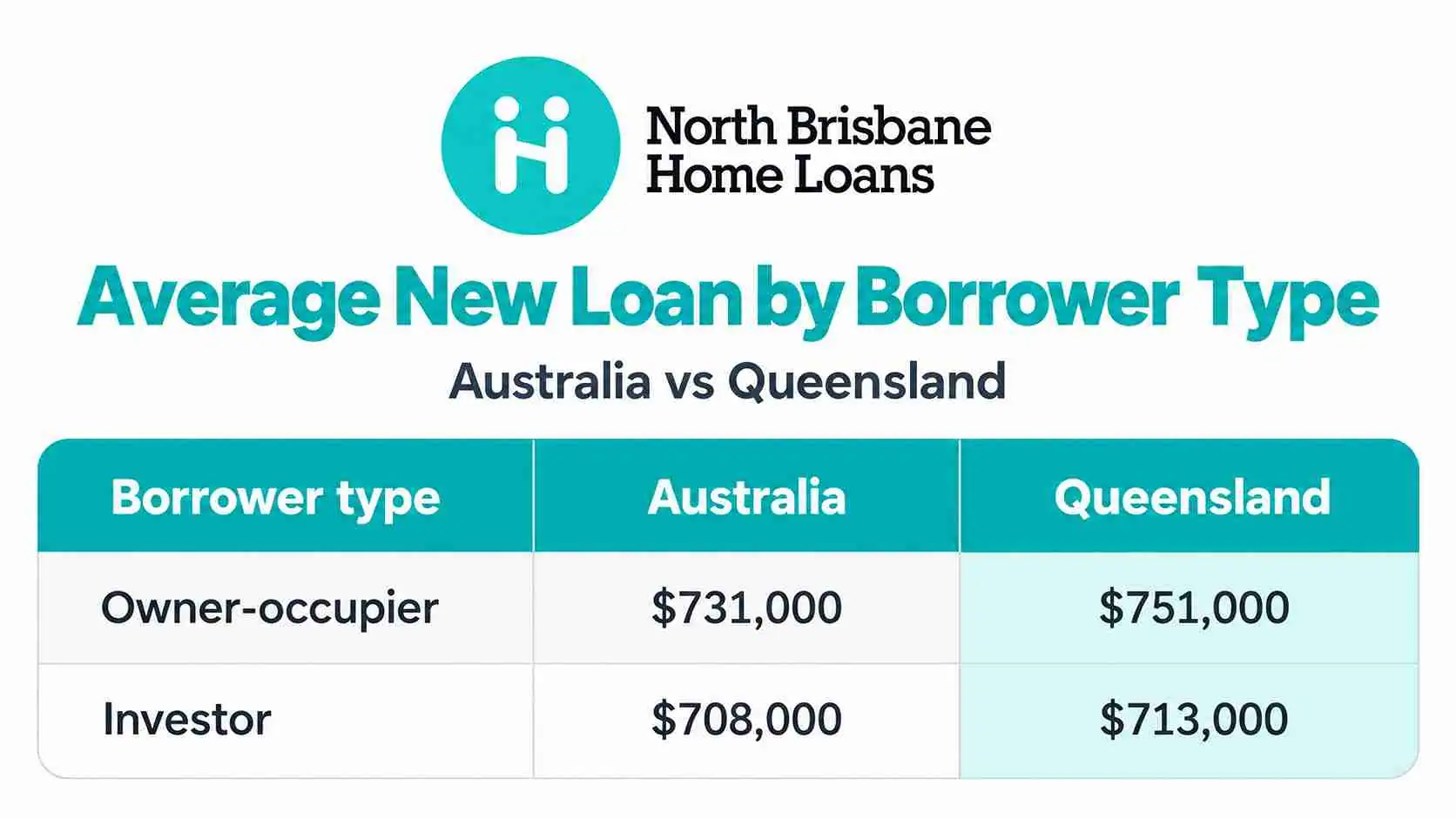
In the second quarter of 2026, the average Australian home loan for investors was $708,000, compared with $731,000 for owner-occupiers. In Queensland, investors averaged $713,000 against $751,000 for owner-occupiers.
These figures show why it is useful to know which type of borrowing an average refers to. An investor may already have other property debt, rental income and usable equity, while an owner-occupier may be financing their main residence for the first time or moving into their next home.
For investors in particular, the size of the new loan is only one part of the picture. Existing mortgages, rental income, personal income, living expenses and other liabilities can all affect how much a lender is prepared to advance for another property.
How Australian Home Loan Rates Changed From 2024 to 2026
The size of your mortgage is important, but the interest rate attached to it can make just as much difference to your monthly budget.
Australia has experienced some significant changes in home loan conditions over the past three years.
2024: The Cash Rate Remained High
The cash rate remained at 4.35% throughout 2024.
For borrowers with variable home loans, this meant repayments remained under pressure for much of the year, particularly for households that had borrowed when rates were considerably lower.
2025: Interest Rates Began to Fall
The direction changed during 2025.
The cash rate fell to:
- 4.10% in February
- 3.85% in May
- 3.60% in August.
It remained at 3.60% through the end of the year.
2026: Rates Rose Again
The rate cycle changed direction again in 2026.
The cash rate increased to:
- 3.85% in February
- 4.10% in March
- 4.35% in May
- 4.60% from 30 September 2026.
You can see the full sequence in the official Australian cash rate history. The current cash rate matters because it influences mortgage pricing across the market, although it is not the same thing as the interest rate your lender charges. How the cash rate influences other interest rates explains that connection.
For borrowers, the key lesson from 2024–2026 is that repayments can move in both directions.
The infographic below summarises the 2024–2026 rate cycle.
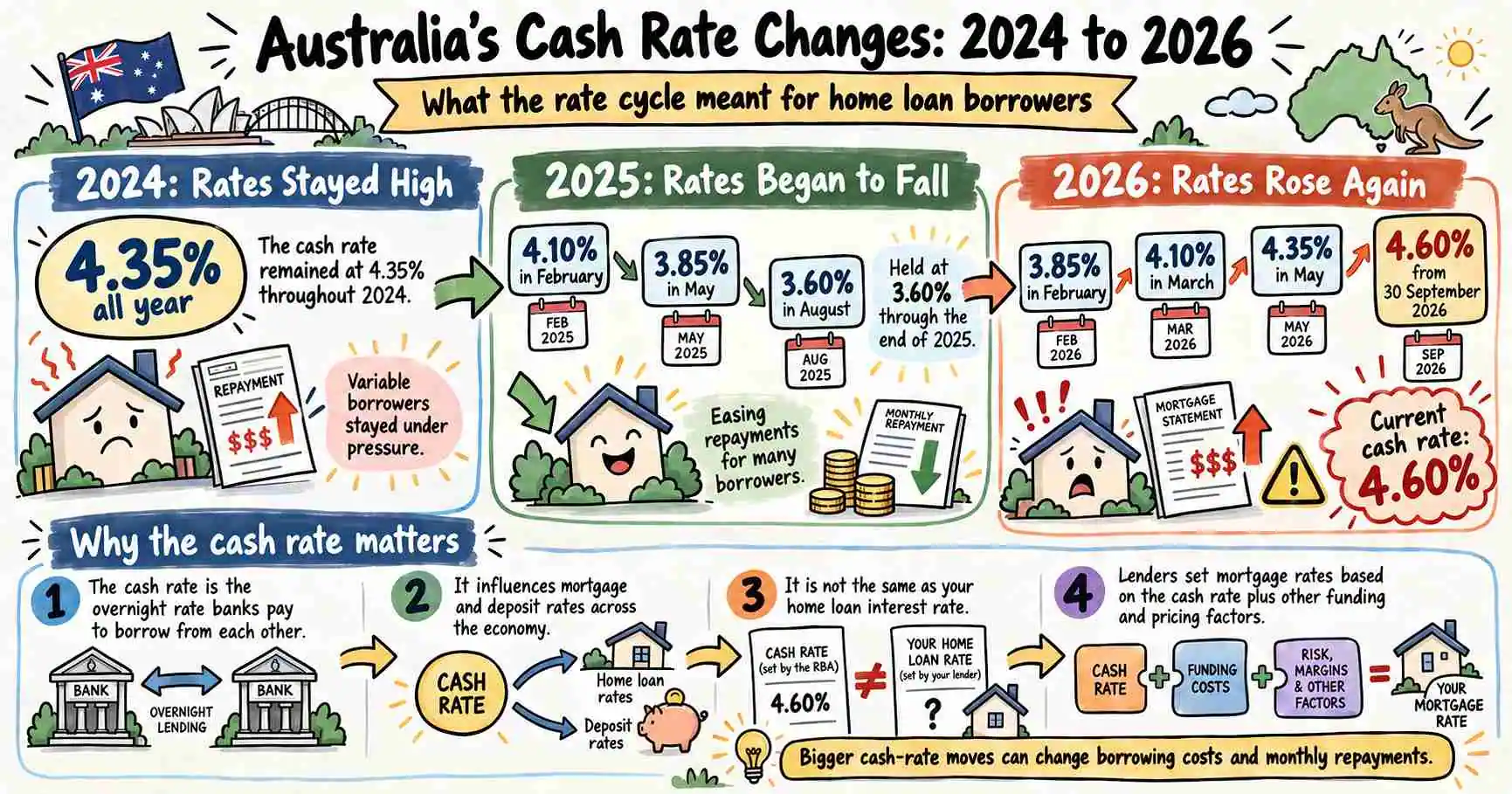
A loan that looked comfortable when rates were lower can become much tighter when rates rise. That is why it can be useful to test your budget at more than one interest rate rather than focusing only on today’s repayment.
What is the Current Average Home Loan Interest Rate?
The Reserve Bank publishes actual average lending rates across the Australian banking system.
In August 2026, the average rate on new owner-occupier housing loans was 6.24%, while new owner-occupier principal-and-interest loans averaged 6.15%, according to the RBA’s housing lending rate data. The RBA releases these figures with a time lag, so the August averages were recorded before the cash rate rose to 4.60% on 30 September 2026. As lenders pass that increase on, rates on new loans are likely to sit above these averages.
The actual rate available to you may be above or below the market average.
It can depend on factors such as:
- lender
- loan-to-value ratio
- owner-occupied or investment purpose
- loan amount
- fixed or variable rate
- principal-and-interest or interest-only repayments
- available lender discounts
- your overall application.
If you already have a mortgage and your rate is materially above current alternatives, that does not automatically mean you should refinance—but it is a good reason to review the loan.
What are Average Mortgage Repayments?
There is no single official figure that represents average mortgage repayments for every Australian household.
Two people can owe exactly the same amount and still have very different repayments because of their interest rate, remaining loan term and repayment structure.
To see how much that can matter, consider the current average new owner-occupier loan of $731,000 over the course of 30 years.
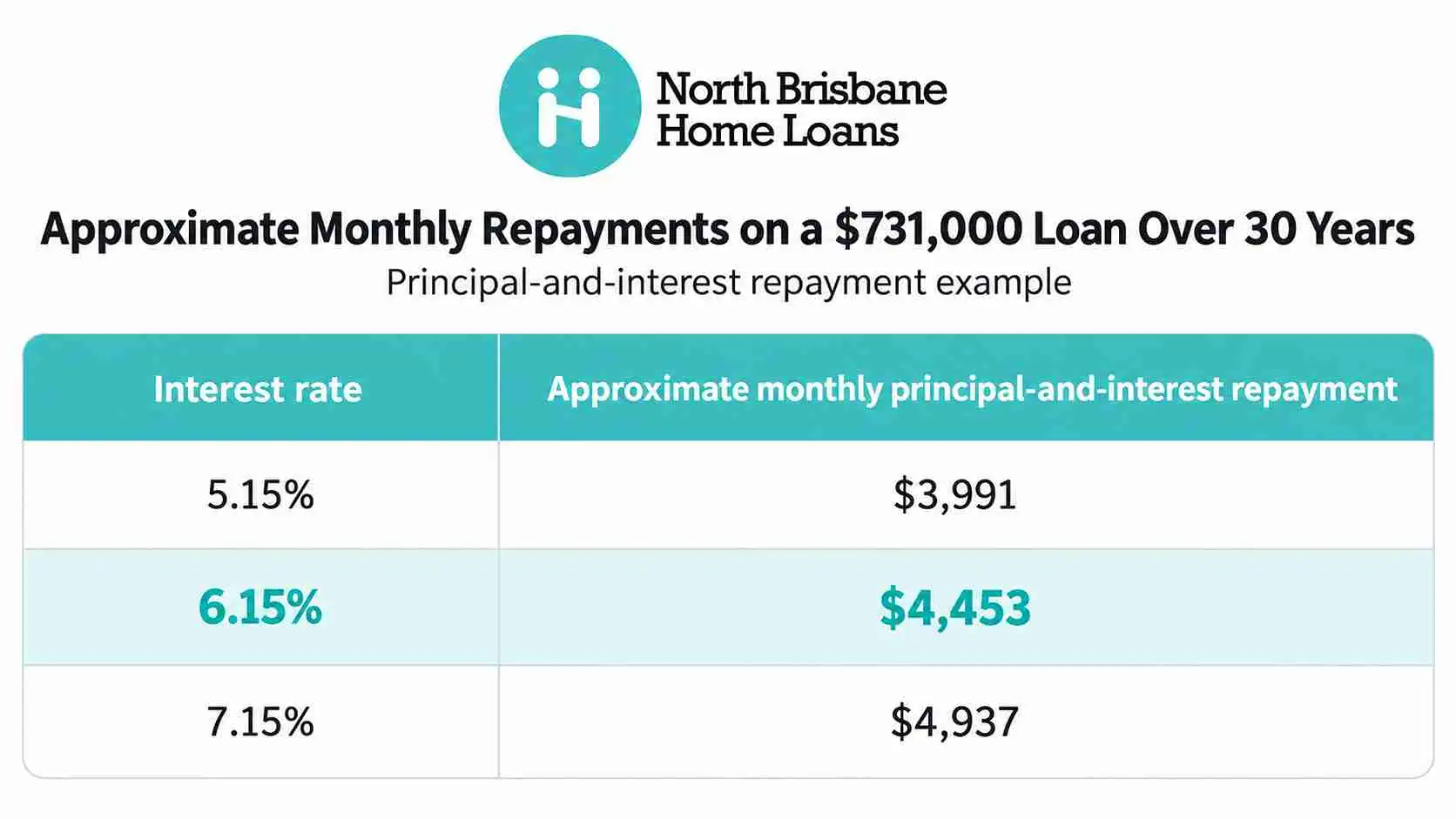
These figures are illustrative only and assume the same $731,000 balance and 30-year term.
The 6.15% example is based on the current average rate for new owner-occupier principal-and-interest lending. Moneysmart’s mortgage calculator can also help borrowers see how changing a rate or loan term affects repayments.
A two-percentage-point difference between 5.15% and 7.15% changes the monthly repayment in this example by approximately $946.
That can make a major difference to a household budget.
If you are thinking about buying or refinancing, NBHL can compare the repayment impact across suitable lenders rather than looking only at the headline interest rate.
How Interest Rates Can Change Your Mortgage Repayments
Interest rates have a direct effect on the cost of borrowing.
With a variable-rate loan, an increase in your lender’s rate will generally increase the amount of interest charged. Depending on your lender and loan structure, your required repayment may increase as a result.
If rates fall, repayments may decrease—but borrowers can also choose to maintain higher repayments where their loan permits it, potentially reducing the principal faster.
Fixed-rate loans work differently.
Your rate is generally locked in for the agreed fixed period, which can provide repayment certainty. However, once that period ends, the loan may move to a variable revert rate unless you refinance or enter another fixed-rate arrangement.
The differences between fixed and variable home loan rates are worth understanding before choosing a loan structure, particularly when rates are moving.
For borrowers close to purchasing, it can be useful to compare repayments at the rate available today and at a higher rate to see how much room is left in the household budget.
What is a Mortgage Comparison Rate?

When comparing home loans, the advertised interest rate is not the only number worth checking.
A comparison rate combines the interest rate with most fees and charges into a single percentage designed to make the cost of different credit products easier to compare.
Australia’s comparison rate requirements under the National Credit Code require a comparison rate to be displayed when applicable fixed-term consumer credit is advertised. However, the comparison rate does not include every possible cost.
For example, it generally does not include government charges or fees that only apply in particular circumstances. It also does not tell you whether the loan gives you features that may be valuable to you.
An offset account, redraw facility, flexible repayment options or a suitable fixed/variable structure can all affect whether a loan represents good value for your situation.
ASIC’s Moneysmart guidance recommends comparing rates, fees, loan features and the personalised key facts sheet when assessing home loan options. Knowing how to compare home loans on a like-for-like basis can help you understand what to look for beyond the advertised rate. This is also where a broker can help: rather than comparing one number, we can look at the overall loan structure.
Does the Average Australian Home Loan Tell You How Much You Can Borrow?
The short answer is no.
Your borrowing capacity is based on your own financial position, not on the average Australian home loan.
When assessing a home loan, lenders may consider:
- income
- living expenses
- credit cards
- personal and car loans
- existing mortgages
- dependants
- deposit or equity
- credit history
- loan term
- interest rate
- lender policy
Australia’s responsible lending requirements for consumer credit require relevant credit licensees to make reasonable inquiries about a consumer’s financial situation, requirements and objectives and take reasonable steps to verify the financial information used in the assessment.
You may see fixed percentages quoted for each stage, but these shouldn’t be treated as a universal Queensland construction-loan schedule.
The actual amounts and stages should be set out in the building contract and need to reflect the work being performed.
Queensland’s current rules for building deposits and progress payments state that, for contracts valued above $3,300, the number and timing of progress payments can be negotiated between the homeowner and contractor, but the payments must be relative to the value of work completed. For example, a builder cannot claim more than 50% of the contract price, including the deposit, until at least 50% of the onsite work has been completed.
That means the question is not:
“Can I get the average Australian mortgage?”
The right question is:
“What loan amount can I comfortably service and what will suitable lenders allow me to borrow?”
If you are planning a purchase, our guide to how lenders calculate your borrowing power explains the main factors that can affect your borrowing range.
How Lenders Test Whether You Could Afford the Loan

The rate you see advertised is not necessarily the rate used to assess whether you can afford the loan.
For banks and other APRA-regulated lenders, the current mortgage serviceability buffer remains 3 percentage points above the loan interest rate. Current mortgage serviceability requirements for regulated banks confirm that the buffer remained unchanged in May 2026.
For example, if a regulated lender is assessing a loan with an interest rate of 6%, the serviceability assessment may need to consider your ability to meet repayments at around 9% (6% plus the 3-point buffer).
The purpose is to create a margin for potential increases in interest rates or changes in the borrower’s income and expenses.
This is one reason your borrowing power may be lower than the amount suggested by a borrowing calculator .
What Do the Current Debt-to-Income Rules Mean for Borrowers?
Debt-to-income, or DTI, compares a borrower’s total debt with their gross annual income.
From 1 February 2026, APRA introduced limits on high debt-to-income mortgage lending for regulated banks.
The rules allow up to 20% of new owner-occupier lending and 20% of new investment lending to borrowers with DTI ratios of six times income or more. The limits apply separately to the two lending categories.
Importantly, this is not an automatic rule that every borrower above six times income must be declined.
It is a portfolio-level restriction on regulated lenders.
However, if you have a high level of existing debt relative to your income, lender selection and the structure of your application may become particularly important.
Is an Average-Sized Mortgage Affordable?
Not necessarily.
The word “average” says nothing about whether a loan is comfortable for your household.
A $731,000 mortgage might be manageable for one household and put another under significant financial pressure.
Before deciding what you can afford, consider what the repayments leave you with after paying for:
- groceries and utilities
- insurance
- council rates
- strata costs where applicable
- childcare
- transport
- maintenance
- other debts
- savings
- emergency expenses
It is also worth thinking beyond today’s rate.
If your budget would become uncomfortable after a relatively small increase in repayments, borrowing below the maximum amount a lender will approve may give you more financial flexibility.
The aim is not simply to qualify for the loan.
It is to still be comfortable with the loan after you move into the property.
What Does the Average Mean for First Home Buyers, Upgraders and Investors?
Different borrowers can look at the same average mortgage figure and be in completely different financial positions.
For First Home Buyers
First home buyers may be building their deposit from savings without the benefit of existing property equity.
The amount they can borrow can therefore be particularly sensitive to income, savings, existing debts and lender policy.
If you’re approaching your first purchase, comparing first home buyer loan options can give you a much more useful picture than comparing yourself with the national average.
For Home Upgraders
An upgrader may have accumulated substantial equity in an existing property.
That equity can potentially form part of the contribution to the next purchase, which means a more expensive property does not necessarily require borrowing the same percentage of the purchase price as a first home buyer.
For Property Investors
An investor may already have several financial commitments.
The lender may consider rental income, existing mortgages, personal income, property expenses and other liabilities as part of the assessment.
That is why the average investor loan amount should be treated as market context—not as an indication of how much another investor can or should borrow.
Should You Refinance Because Your Mortgage Is Above Average?

Not simply because it is above average.
A large mortgage can still be competitive and appropriately structured. A smaller mortgage can still be costing the borrower more than necessary.
Instead, ask:
- What interest rate am I paying?
- What is my comparison rate?
- Are there more competitive alternatives?
- Am I paying for features I do not use?
- How much equity do I have?
- What would refinancing cost?
- Would a lower rate actually save money after fees?
- Would the new loan extend my repayment term?
If your mortgage has not been reviewed recently, the national average can be a useful prompt to check where you stand—but the decision should be based on your own loan.
Our refinance home loan options explain what to consider before switching lenders.
How to Use Average Mortgage Data When You’re Ready to Buy
The average mortgage can help you understand what is happening across the lending market.
It can show you whether new loan sizes are rising or falling, how Queensland compares with the rest of Australia and how borrowing has changed as interest rates move.
But when you are actually ready to buy, the national average becomes much less important than your own numbers.
Before setting your property budget, it is worth knowing:
- how much you can reasonably borrow
- what deposit you need
- what repayments could look like
- how repayments change at higher rates
- which lenders may suit your circumstances
- what loan features are genuinely useful to you.
That gives you a much stronger starting point for making an offer than simply knowing what the average borrower is doing.
Talk to North Brisbane Home Loans About Your Borrowing Options
The average Australian home loan gives you useful context, but it cannot tell you what mortgage is right for you.
North Brisbane Home Loans can help you look at your income, expenses, deposit or available equity and property plans to understand what your options may look like.
We can then compare suitable lenders, rates, loan features and borrowing policies so you can make your decision using numbers that are relevant to your situation.
Whether you are buying your first home, upgrading, investing or reviewing an existing mortgage, the next step is understanding your borrowing position rather than the national average.
Frequently Asked Questions About the Average Australian Home Loan
Is the Average Australian Home Loan the Same as the Average Mortgage Balance?
No.
The main figures used in this guide relate to new dwelling loan commitments. They do not represent the average outstanding balance owed by every Australian mortgage holder.
This distinction is especially important for people who have already been repaying their mortgage for several years.
Does the ABS Average Home Loan Data Include Refinancing?
The dwelling loan commitment data used for the main figures in this article excludes refinancing.
The official housing lending statistics and definitions confirm that the series covers new dwelling commitments rather than refinanced loans.
Is the Queensland Average Home Loan the Same as the Brisbane Average?
No.
The $751,000 figure is a Queensland-wide average.
Individual Brisbane suburbs and property types can have very different purchase prices, so it should not be treated as a Brisbane borrowing target.
How Often Do Average Australian Home Loan Figures Change?
The ABS releases its Lending Indicators data quarterly.
Loan averages can therefore change four times a year. Lending Indicators moved from monthly to quarterly from December 2024 as new loans are written and the mix of borrowers and property purchases changes.
Is Having a Mortgage Above the Australian Average a Bad Thing?
Not necessarily.
The amount of debt needs to be considered alongside your income, expenses, equity, interest rate and ability to comfortably meet the repayments.
A loan above the national average can still be manageable for one household, while a smaller loan may be difficult for another.
Should I Use the Average Mortgage to Set My Property Budget?
No.
Your property budget should be based on what you can reasonably borrow and comfortably repay.
Averages are useful for understanding market trends, but they cannot account for your deposit, income, living expenses, debts or financial goals.
Can a Mortgage Broker Tell Me How Much I Could Borrow Before I Start Looking?
Yes. A broker can review your financial position and compare lender policies to give you a clearer idea of the borrowing range that may be available.
That can help you set a more realistic property budget before you start making offers.
Disclaimer: The information in this article is general in nature and does not take into account your objectives, financial situation or needs. Loan sizes, interest rates, lending policies and regulatory settings can change. Figures quoted are historical or current at the publication date and should be checked before relying on them for a financial decision.