
Best Brisbane Suburbs to Buy a Home: A Practical Guide
Brisbane suburbs offer homebuyers plenty of choice, from established inner-city neighbourhoods and leafy family communities to growing northern corridors and relaxed bayside locations. But deciding where to buy isn’t always straightforward, particularly when property prices, borrowing capacity and lifestyle priorities all need to work together.
Whether you’re a first-home buyer looking for somewhere affordable, a growing family needing more space or an existing homeowner planning an upgrade, choosing the right location can make a significant difference to your lifestyle and finances.
And with the Brisbane property market experiencing a change in conditions during 2026, understanding the differences between suburbs has become even more important.
At North Brisbane Home Loans (NBHL), we understand that buying a home isn’t simply about finding a property you like. It’s also about understanding what you can comfortably borrow, what you’ll need upfront and whether your preferred area fits your long-term plans.
In this guide, we’ll explore some of the best suburbs in Brisbane to consider, what makes different locations appealing and how to narrow down your options before making an offer.
Looking to buy a home in Brisbane? Before you start inspecting properties, speak with our Brisbane mortgage brokers about your borrowing capacity and home loan options. Knowing where you stand financially can make your suburb search considerably easier.
Understanding the Brisbane Property Market in 2026
Brisbane’s housing market has experienced substantial changes in recent years.
Strong population demand, limited housing availability and growing interest in South East Queensland helped drive property prices higher in previous years.
However, market conditions have shifted during 2026.
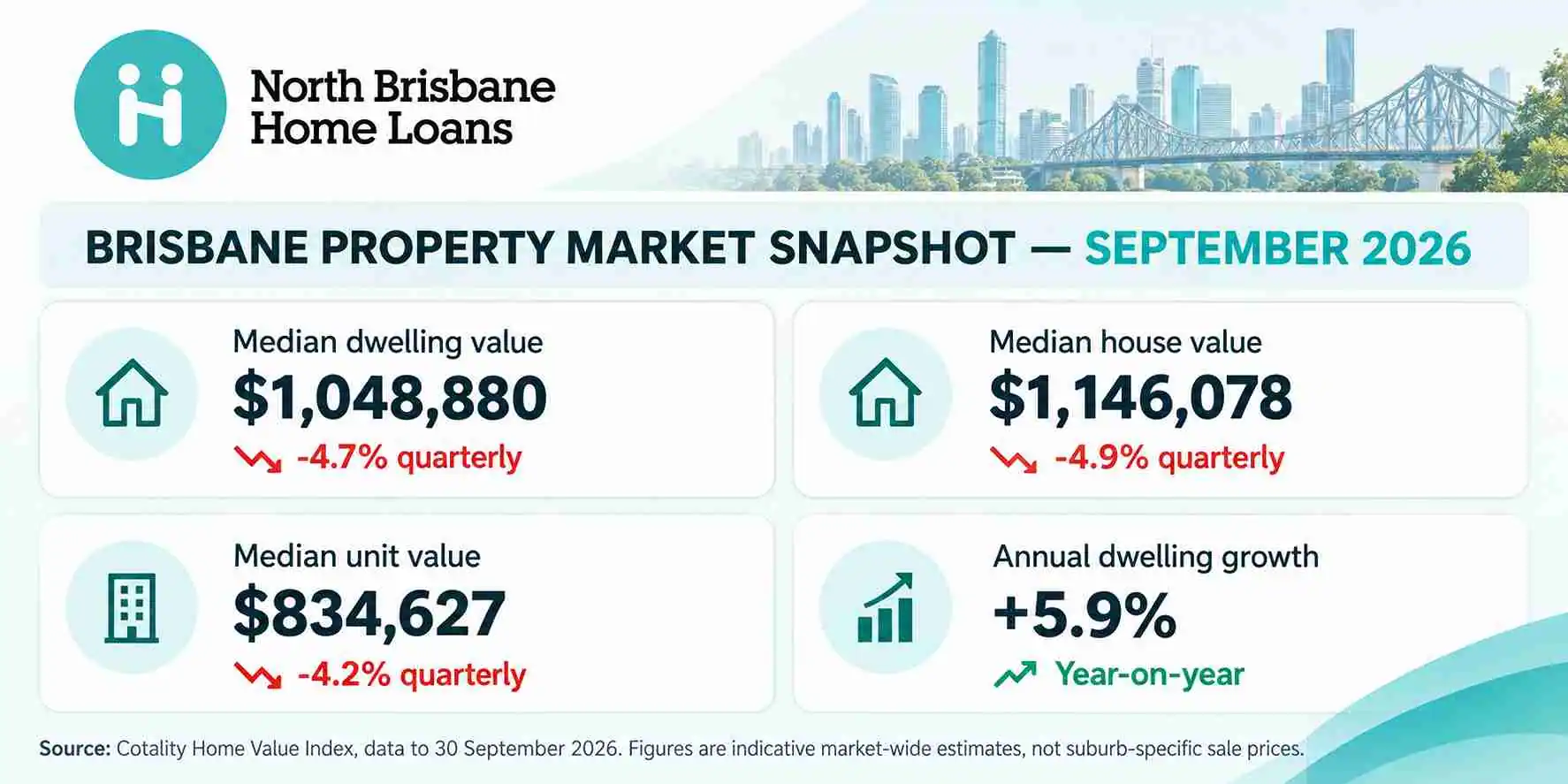
Higher borrowing costs and affordability pressures have contributed to slower buyer activity, more homes for sale and weaker property price growth. By September, Brisbane had moved into a period of declining values, although prices remained above their levels from a year earlier.
According to Cotality’s September 2026 housing figures, the Brisbane property market recorded the following results:
One important development is that homes are taking longer to sell.
Cotality’s October Housing Chart Pack reported that advertised Brisbane listings had increased by 60.4% over the preceding year, while median selling times had risen from 17 to 38 days.
What Does This Mean for Brisbane Homebuyers?
A slower market may give some buyers more time to inspect properties, compare options and negotiate. However, it doesn’t mean all Brisbane suburbs or properties will experience the same price movements.
Desirable homes in well-connected locations may still attract competition, while properties requiring major renovations or carrying additional risks may be harder to sell.
Rather than trying to predict exactly when the market will bottom out, we recommend focusing on three questions:
- Can you comfortably afford the property, including repayments and ongoing ownership costs?
- Does the suburb suit your current lifestyle and likely needs over the next five to ten years?
- Are you paying a reasonable price compared with recent sales of similar properties?
It’s also worth remembering that a lower purchase price doesn’t automatically mean a property is better value. Construction quality, location, flood exposure, maintenance requirements and future resale appeal all matter.
Brisbane Suburbs at a Glance: Map and Shortlist

| Suburb | Buyer Category | Why It Was Selected |
| Chermside | First-home buyers | Mix of apartments, townhouses and houses, major shopping facilities, healthcare services and transport connections. |
| Strathpine | First-home buyers | Established residential areas, rail access and an alternative to inner-north Brisbane locations. |
| North Lakes | First-home buyers | Modern housing estates, family amenities, parks and shopping facilities. |
| Albany Creek | Families | Established family homes, schools, parks and residential neighbourhoods. |
| Aspley | Families | Established housing, shopping centres, nearby schools and access to major roads. |
| The Gap | Families | Leafy surroundings, outdoor recreation and established family communities. |
| Kedron | Professionals | Proximity to central Brisbane, established housing and access to major transport corridors. |
| Stafford | Professionals | Convenient northside location, shopping facilities and a mixture of houses and townhouses. |
| Nundah | Professionals | Rail connections, village amenities, cafes and apartment options. |
| Everton Park | Upgraders | Established homes, shopping and dining amenities, and renovation opportunities. |
| Wavell Heights | Upgraders | Mix of traditional and renovated homes, established streets and potential larger family homes. |
| McDowall | Upgraders | Residential environment, parks, schools and established family housing. |
| Sandgate | Bayside lifestyle | Coastal recreation, heritage character, cafes and rail access. |
| Brighton | Bayside lifestyle | Quieter residential environment and proximity to Moreton Bay. |
| Redcliffe | Bayside lifestyle | Waterfront facilities, recreation, dining and varied housing options. |
NOTE: These are illustrative suburb shortlists rather than affordability or investment rankings. North Lakes, Strathpine and Redcliffe are in the City of Moreton Bay, within Greater Brisbane.
What Do Resident Reviews Reveal About Brisbane Suburbs?
When comparing Brisbane suburbs, property prices and access to amenities are important, but they don’t always tell the whole story. Understanding what residents actually think about their neighbourhoods can offer valuable insight into everyday living, including neighbourhood atmosphere, transport, schools, parks and local facilities.

Based on resident feedback published on Homely’s Brisbane suburb ratings and reviews, several patterns emerge about what people appreciate most and the common drawbacks they experience.
1. Family-Friendly Suburbs Tend to Receive Higher Ratings
Suburbs with established residential neighbourhoods, parks, schools and a strong sense of community generally attract positive feedback from residents.
Brighton, Albany Creek, Aspley, McDowall and Everton Park, for example, all received ratings of at least 4.4 out of 5 in the reviews examined in October 2026.
Residents frequently highlight green spaces, access to schools, family-friendly facilities and quieter residential streets as reasons they enjoy living in these areas.
However, higher resident satisfaction doesn’t necessarily mean these suburbs will suit every homebuyer. Property prices, transport options and the availability of suitable homes still need to be considered.
2. Convenience Doesn’t Always Mean Greater Resident Satisfaction
You might expect suburbs with major shopping centres, healthcare facilities and plenty of local services to receive the highest ratings.
Interestingly, that isn’t always the case.
Chermside and North Lakes offer extensive retail facilities, modern amenities and convenient access to everyday services. However, both received more mixed resident reviews, with ratings of 3.5 out of 5 in the sample examined.
Some residents raised concerns about traffic congestion, increasing housing density and smaller residential blocks.
This suggests an important consideration for homebuyers: having everything nearby doesn’t necessarily mean a suburb will provide the lifestyle you’re looking for.
For some people, convenience is the priority. Others may prefer quieter streets, larger properties or less traffic.
3. Good Transport Connections Come With Trade-Offs
Access to public transport and major roads can make a suburb attractive, particularly for professionals commuting to work.
Nundah, for instance, receives positive feedback for its train connections, cafes and village atmosphere. However, some reviewers also mention parking difficulties, traffic and increasing apartment density.
Sandgate offers a different lifestyle, with waterfront walks, heritage character and a relaxed coastal atmosphere contributing to its favourable 4.3 out of 5 rating.
The trade-off? Some residents find commuting by car less convenient, particularly when travelling into central Brisbane.
When choosing between Brisbane suburbs, it’s worth considering how often you’ll need to travel, whether public transport is practical and how traffic might affect your daily routine.
A location that works well for someone working from home may be less suitable for somebody commuting to the CBD five days a week.
4. The Street You Choose Can Matter as Much as the Suburb
One of the most useful lessons from resident reviews is that experiences can vary considerably within the same suburb.
A home on a quiet residential street may offer a very different lifestyle from a property beside a busy road, shopping centre or major transport corridor.
Residents frequently mention factors such as traffic noise, parking availability, housing density and proximity to amenities when describing their neighbourhoods.
That’s why suburb ratings should be treated as a starting point rather than the deciding factor when buying a home.
Before committing to a property, consider visiting the street at different times of the day, checking local planning information and investigating potential flooding, building or insurance concerns.
How to Use Resident Reviews When Choosing a Suburb
Resident reviews can help you identify suburbs worth investigating, but they shouldn’t replace your own research, property inspections, local council checks or an assessment of your financial circumstances.
A highly rated suburb may be outside your budget, while a lower-rated suburb could offer the right property, location and amenities for your circumstances.
The best Brisbane suburb to buy a home in is ultimately the one that balances your lifestyle priorities with what you can comfortably afford.
Rather than choosing a location based on popularity or star ratings alone, compare several suburbs, inspect individual properties and understand your borrowing capacity before making a decision.
Note: Resident ratings referenced above were reported from Homely suburb profiles in October 2026. Ratings reflect user-generated opinions, are based on relatively small and varying numbers of reviews, and may change over time. They should not be interpreted as official measures of property value, safety or investment potential.
Best Brisbane Suburbs to Consider for Different Homebuyers
There isn’t one suburb that suits every buyer.
A young professional who wants a short commute may have different priorities from a family looking for more bedrooms and outdoor space. Likewise, someone buying their first home may need to balance affordability with access to employment, public transport and essential services.
The following Brisbane suburbs are worth investigating depending on your circumstances and property preferences.
1. Brisbane Suburbs for First-Home Buyers

For many first-home buyers, affordability and access to amenities are major considerations.
That doesn’t always mean searching for the cheapest suburb. Instead, it’s about finding an area where your preferred property type fits your budget without compromising too heavily on your lifestyle.
Chermside
Chermside is a major northside centre with a combination of apartments, townhouses and established houses.
With shopping facilities, healthcare services and public transport connections, it appeals to buyers who value convenience. Apartments may provide an alternative for buyers who find detached houses beyond their budget.
Consider: Body corporate fees, building condition, traffic noise and differences between individual apartment complexes.
Strathpine
Situated north of Brisbane in the Moreton Bay region, Strathpine offers established residential neighbourhoods, rail access and everyday shopping facilities.
Buyers willing to live farther from the CBD may find housing alternatives worth comparing with inner-north suburbs.
Consider: Commute times, property age, renovation costs and street-specific flood information.
North Lakes
North Lakes is known for its planned residential communities, shopping facilities, parks and relatively modern housing stock.
It may appeal to first-home buyers seeking a contemporary home without taking on extensive renovation work.
Consider: Smaller lots in some estates, road congestion, estate restrictions and the fact that rail stations are located in neighbouring Mango Hill rather than within North Lakes itself.
When comparing Brisbane suburbs as a first-home buyer, it’s important to look at the total cost of purchasing and owning a property, not just the advertised price.
A newer townhouse or apartment may reduce certain maintenance concerns, but ongoing body corporate costs can affect affordability.
2. Best Brisbane Suburbs for Families

Families often place greater importance on the number of bedrooms, outdoor space, access to schools, parks and community facilities.
Several established Brisbane suburbs offer these features, although property prices and housing availability can vary considerably.
Albany Creek
Albany Creek offers a suburban environment with established homes, schools, parks and local shopping facilities.
Its mix of residential streets and community amenities may suit families wanting space while maintaining access to Brisbane’s northside.
Consider: The condition of older properties, school catchment boundaries and differences in travel times between individual streets.
Aspley
Aspley is an established northern suburb with a mixture of post-war houses, renovated homes and some newer residential developments.
Shopping facilities, nearby schools and connections to major roads make it worth considering for families who want established infrastructure.
Consider: Renovation requirements, traffic exposure near major roads and the quality of individual properties.
The Gap
Located west of Brisbane’s CBD, The Gap is known for its leafy setting, outdoor recreation opportunities and established residential communities.
It may appeal to families who prefer a quieter environment and access to natural surroundings.
Consider: Reliance on road and bus transport, bushfire considerations in relevant locations and the suitability of individual properties for your household.
These are only a few possible choices. Families comparing schooling, parks and community facilities can explore our dedicated guide to the best Brisbane suburbs for families for a more detailed comparison.
Before choosing a home based on a nearby school, check its actual catchment. A property’s proximity to a school does not necessarily mean it falls within that school’s enrolment area.
3. Brisbane Suburbs for Professionals and Commuters

For professionals working in or around the CBD, access to transport can influence both property choice and everyday living costs.
An attractive house may not be the right purchase if the journey to work becomes difficult or expensive.
Kedron
Kedron combines established residential streets with access to major northside roads, bus services and nearby shopping and healthcare facilities.
It can suit buyers wanting a suburban setting without moving too far from central Brisbane.
Consider: Road noise near major corridors, peak-hour traffic, the condition of older housing stock and how practical bus services are for your commute.
Stafford
Stafford offers a mix of houses, townhouses and access to nearby retail precincts.
For professionals who want space and a relatively convenient northside location, it presents a range of housing possibilities.
Consider: Reliance on buses or private vehicles in some pockets, commute times, body corporate costs for townhouses and differences between individual streets.
Nundah
Nundah is worth investigating for buyers who place a high priority on rail access and local convenience.
Its village-style centre, cafes, retail facilities and nearby residential streets provide a mix of apartment and house options.
Consider: Aircraft noise exposure, proximity to the rail line, body corporate costs and the quality of individual apartment buildings.
4. Brisbane Suburbs for Upgraders Seeking More Space

An existing homeowner looking to upgrade may have more purchasing flexibility, particularly if they have built equity in their current property.
However, moving into a larger home can also mean higher mortgage repayments, insurance, rates and maintenance costs.
Everton Park
Everton Park combines established housing with shopping, dining and access to nearby employment and transport corridors.
Upgraders may be attracted to renovated family homes or properties with opportunities for improvement.
Consider: Higher prices for larger blocks and renovated homes, the cost of improving unrenovated properties and street-specific flood information.
Wavell Heights
Wavell Heights has a mixture of traditional Queensland housing, renovated properties and newer homes.
Its established residential character and northside location may appeal to buyers seeking more bedrooms or space for a growing household.
Consider: Renovation quality, block size and slope, the maintenance needs of older homes and the distance to the nearest train station.
McDowall
McDowall offers residential streets, parks and access to nearby schools and services.
For families upgrading from a smaller home, its established housing stock may be worth exploring.
Consider: Limited availability in some price brackets, reliance on car and bus transport and the condition of established homes. Keeping a shortlist of nearby alternatives is sensible.
If you’re selling an existing home to finance your next purchase, we recommend discussing your borrowing capacity and purchase timing before committing to a property.
5. Brisbane Suburbs for a Bayside Lifestyle

For buyers who prefer coastal walks, waterfront recreation and a more relaxed atmosphere, Brisbane’s northern bayside areas may be appealing.
Sandgate
Sandgate offers a distinctive coastal setting, heritage character, cafes and rail connections.
Its proximity to Moreton Bay attracts buyers interested in an outdoor lifestyle while retaining access to central Brisbane.
However, desirable coastal homes can command premium prices.
Consider: Flood and storm-tide exposure for the individual address, insurance costs, coastal maintenance and car commute times into the city.
Brighton
Brighton provides a quieter residential setting close to Moreton Bay, with established homes and waterfront recreation opportunities.
It may suit families or upgraders who prioritise lifestyle and are comfortable with a longer journey to the city.
Consider: Property condition, coastal and storm-tide exposure, limited direct rail access and travel times to the city.
Redcliffe
Redcliffe, part of the City of Moreton Bay, offers waterfront amenities, dining, recreation and a range of housing types.
It may appeal to buyers wanting a bayside location without necessarily purchasing directly on the waterfront.
Consider: Distance from the CBD, commute practicalities (the nearest rail station is at Kippa-Ring), storm-tide exposure and City of Moreton Bay flood information for the specific address.
Although these bayside Brisbane suburbs share coastal appeal, individual properties can vary considerably in price, condition and exposure to environmental risks.
Comparing Brisbane’s North, South, East, West and Inner Suburbs
Choosing between different regions of Brisbane can help narrow your property search before you begin comparing individual Brisbane suburbs. Here is a table that can help you find out more about these Brisbane regions:

These comparisons are broad. Individual streets, developments and properties can be very different even within the same suburb.
For example, two houses just a few streets apart may have substantially different land characteristics, traffic exposure or building conditions.
This is why suburb research should always be followed by property-level due diligence.
How to Choose the Right Brisbane Suburb for Your Budget and Lifestyle
Finding the right Brisbane suburb involves more than identifying a location with attractive houses.
The following considerations can help you narrow down your shortlist and avoid common buying mistakes.
1. Start With Your Borrowing Capacity
Before attending open homes, understand the price range you can realistically afford.
Your borrowing capacity depends on more than your salary. Lenders also assess existing debts, household spending, dependants and financial commitments.
Two buyers with similar incomes may receive different borrowing assessments because their circumstances differ.
For example, high credit card limits, car loan repayments or childcare costs may influence what a lender is prepared to offer.
Our guide to how household expenses can affect your home loan borrowing capacity explains why lenders look beyond income when assessing affordability.
At NBHL, we can also compare suitable lending options across 40+ lenders on our panel, helping you understand what may be available for your circumstances.
2. Consider Your Lifestyle Over the Next Five to Ten Years
A suburb that suits you today may not be the right fit in several years.
Think about your likely requirements if your household changes, you begin working from home or your children start school.
Ask yourself:
- Will the home have enough bedrooms and usable living space?
- Are shops, healthcare services and recreation facilities nearby?
- How practical is the daily commute?
- Would you still enjoy living there if your circumstances changed?
- Could the home’s layout accommodate different needs without major renovations?
Buying a property usually involves substantial upfront and selling costs, so considering your longer-term needs may help avoid moving again sooner than planned.
3. Check Schools and Transport
School access is important for many households, but catchment boundaries can change.
Before making a decision, confirm the relevant state school catchment and understand any enrolment requirements.
Public transport should also be assessed at the times you actually expect to use it.
A suburb may appear well connected on a map, but service frequency, parking availability and peak-hour travel times can make a considerable difference.
If you’re relocating and choosing a suburb in Brisbane for the first time, try visiting your shortlisted areas on both weekdays and weekends to understand the local environment.
4. Investigate Flooding, Insurance and Property Risks
Flood exposure is an important consideration when buying in South East Queensland.
Before purchasing, check the relevant property’s flood information, building condition and insurance costs.
For properties within Brisbane City Council, the Brisbane FloodWise Property Report provides technical information that can help buyers investigate potential flood-related constraints.
For properties in surrounding council areas, consult the relevant local government rather than assuming Brisbane City Council’s mapping covers the address.
You should also consider obtaining a suitable building and pest inspection and reviewing planning or development restrictions before proceeding with a purchase.
5. Look Beyond the Median House Price
Median prices are useful for understanding general market conditions, but they don’t tell you what every property in a suburb should cost.
A suburb with a relatively high median house price might still offer more accessible apartments or townhouses.
Likewise, a relatively affordable location may have properties requiring significant renovation work.
When comparing homes, consider:
- Property type, condition and land size
- Recent comparable sales
- Renovation and maintenance requirements
- Council rates and insurance
- Body corporate fees, where applicable
- Access to transport and services
- Any relevant development or environmental constraints
The goal is to understand the total cost of ownership rather than simply buying at the lowest advertised price.
Use a Suburb Scorecard to Narrow Your Choices
If you have several Brisbane suburbs in mind, a simple comparison can make the decision more manageable.
Use this checklist to compare each suburb based on the factors most important to you. Rate each factor between 1 and 5, then add the totals for each suburb up.

You can then compare your shortlisted suburbs side by side.
Remember that a high score doesn’t necessarily mean the suburb is objectively better. It means the location may be a better match for your priorities.
For instance, a buyer working remotely may place less importance on commuting distance, while a household with school-aged children may prioritise local schools and suitable housing.
How Much Can You Afford to Buy in Brisbane?
Property affordability is about more than your deposit.
Before comparing Brisbane suburbs, you’ll need to consider the amount you can borrow, purchase costs and the repayments you can manage comfortably.
Your Deposit and Loan-to-Value Ratio
A 20% deposit is commonly used as a benchmark because it may help buyers avoid lenders mortgage insurance (LMI) on many standard home loans.
However, purchasing with a smaller deposit may still be possible, depending on eligibility, lender policies and available government programs.
For illustration, consider three potential purchase prices.

These are illustrative deposit amounts only. They exclude government assistance, purchase expenses, LMI and other costs. They are not representative suburb median prices.
Having a bigger deposit will reduce how much you need to borrow, but it isn’t always necessary to wait until you’ve saved 20%.
The most suitable approach depends on your finances and available options.
Queensland First-Home Buyer Assistance
Eligible first-home buyers may qualify for Queensland Government concessions that reduce their upfront costs.
For established homes, an eligible first-home buyer may receive a full transfer duty concession at values of $700,000 or less, with partial concessions available below $800,000.
For eligible new homes under qualifying contracts dated from 1 May 2025, a full transfer duty concession is available without a property value cap on the qualifying residential component.
The rules are not identical for existing and new homes, and eligibility requirements must be checked.
From 1 August 2026, there’s also a residency requirement. For contracts entered into on or after that date, buyers must be an Australian citizen, a permanent resident or a specified foreign retiree to claim the home concession, the first home concession or the first home vacant land concession. Temporary residents, including most people on student or temporary work visas, will generally pay full transfer duty, even if they plan to apply for permanent residency later.
You can review the applicable thresholds and conditions when checking Queensland’s first-home transfer duty concessions, and assess the separate provisions for qualifying new-home purchases.
Government assistance can make a difference, but it shouldn’t be the only reason for choosing a property.
Don’t Forget the Ongoing Costs
Home ownership expenses continue after settlement.
In addition to your repayments, you may need to budget for council rates, building insurance, maintenance, utilities, body corporate levies and unexpected repairs.
For example, buying an older house may give you more land but increase maintenance costs. Purchasing an apartment may reduce some upkeep responsibilities while introducing body corporate expenses.
We recommend allowing a reasonable financial buffer rather than committing every available dollar to the purchase.
Is It a Good Time to Buy in Brisbane?
There’s no universal answer to whether now is the best time to buy a home.
Brisbane’s changing market conditions may create opportunities for some buyers, particularly where vendors are more willing to negotiate. However, fluctuating property values also mean buyers need to be careful about overpaying or relying on future capital growth.
The more useful question is whether buying now makes sense for your personal circumstances.
If you have stable finances, sufficient savings and a realistic repayment budget, you may be well placed to consider your options.
However, if purchasing would leave you with very little financial flexibility, waiting until your position improves may be more appropriate.
Property market movements are only one part of the decision.
In our experience, having a clear budget, reviewing suitable lenders and understanding the full costs of buying can be more valuable than trying to predict short-term price movements.
Why Speak to a Mortgage Broker Before Choosing a Brisbane Suburb?

Many buyers begin with a preferred suburb and then try to work out how much they can borrow.
It can be more practical to approach the process the other way around.
Knowing your borrowing capacity early allows you to focus on properties that fit your financial position, rather than spending weeks inspecting homes that may be out of reach.
At North Brisbane Home Loans, we can help you:
- Understand your potential borrowing capacity.
- Compare home loan options across our panel of 40+ lenders.
- Investigate suitable deposit and lending arrangements.
- Understand possible government assistance for eligible buyers.
- Prepare for home loan pre-approval.
- Explore finance options when upgrading or purchasing another property.
Different lenders can assess borrowers differently, which means the right home loan isn’t always the one with the lowest advertised interest rate.
A mortgage broker can help you consider lender policies, loan features, fees and your longer-term needs when comparing options.
Frequently Asked Questions About Brisbane Suburbs
What are the best Brisbane suburbs to buy a home?
The best suburbs in Brisbane depend on your budget, preferred property type and lifestyle. Chermside, Strathpine and North Lakes may be worth considering for buyers comparing different northern housing options. Albany Creek, Aspley and The Gap may appeal to families, while Nundah and Kedron can suit buyers who value access to central Brisbane. Always assess individual properties rather than relying on suburb rankings alone.
Which Brisbane suburb is best for first-home buyers?
There isn’t one suburb that suits every first-home buyer. The right choice depends on borrowing capacity, deposit savings, commuting requirements and whether you prefer a house, townhouse or apartment. Consider comparing properties across several neighbouring suburbs rather than restricting your search to one location.
Are houses or units better value in Brisbane?
That depends on the individual property and your financial circumstances. Units can offer a lower purchase price than detached houses in the same suburb, but may involve body corporate fees and building-specific considerations. Houses may provide more land and flexibility, but can cost more to purchase and maintain. Compare similar recent sales and total ownership expenses.
How do changes in Brisbane property prices affect homebuyers?
Changes in Brisbane property prices can influence affordability, buyer competition and opportunities to negotiate. When prices rise, buyers may need a larger deposit or higher borrowing capacity. When prices fall or stabilise, some buyers may have more time to compare properties and negotiate with sellers. However, market conditions can vary significantly between Brisbane suburbs and property types. Rather than relying on citywide trends alone, it’s important to consider your budget, recent comparable sales and long-term housing needs before purchasing.
How can I check if a Brisbane suburb is prone to flooding?
Start with the local council’s flood mapping and planning information, then investigate the individual property’s history and relevant technical reports. For properties within Brisbane City Council, FloodWise can help identify flood planning considerations. Obtain professional advice where required and check insurance availability and costs before purchasing.
Should I get a home loan pre-approval before looking at Brisbane suburbs?
Getting pre-approval before seriously searching for property can help you understand the approximate amount a lender may be willing to lend, subject to conditions. It can also help you set a realistic price range and prepare for the buying process. However, pre-approval is not a guarantee of final finance approval, and the property must also meet the lender’s requirements.
Is buying in Greater Brisbane different from buying within Brisbane City Council?
Yes, particularly when researching local council services, planning rules and property risks. Greater Brisbane includes surrounding local government areas, such as parts of the City of Moreton Bay. Suburbs including North Lakes, Strathpine and Redcliffe are outside Brisbane City Council, so buyers must consult the relevant local authority for property-specific planning and flood information.
Do I need to be an Australian citizen to get a transfer duty concession in Queensland?
For contracts entered into from 1 August 2026, you must be an Australian citizen, a permanent resident or a specified foreign retiree to claim Queensland’s home, first home or first home vacant land concessions. Temporary residents will generally pay full transfer duty. Check the Queensland Revenue Office website for the current eligibility rules before signing a contract.
Find the Right Brisbane Suburb and Home Loan with NBHL
Choosing where to buy is one of the biggest decisions you’ll make as a homebuyer.
Whether you’re considering an established northside neighbourhood, a growing community in the Moreton Bay region or a bayside property, it pays to understand your finances before making an offer.
At North Brisbane Home Loans, we help first-home buyers, existing homeowners and upgraders explore suitable lending options and prepare for the next step in their property journey.
With access to 40+ lenders on our panel, we can help you compare your options, understand your borrowing capacity and work towards finding a home loan that suits your needs.
Ready to take the next step? Get in touch with North Brisbane Home Loans to discuss your home loan options and start your property search with greater confidence.
Disclaimer: The information in this article is general in nature and does not take into account your objectives, financial situation or needs. Loan sizes, interest rates, lending policies and regulatory settings can change. Figures quoted are historical or current at the publication date and should be checked before relying on them for a financial decision.